Cut toFrame 0304
Home
Service designJul 20204 min readNo. 05
Service design: usability or desirability?
Why a highly usable service isn't automatically a desirable one — with a real case from last-mile operations.
 Words byAmit Chotia

Service design is more than making a service meet a need. And yet we often confuse the job with creating desire for the service — and treat usability and desirability as if they were the same thing.
A design isn't finished until somebody is using it.
Two different jobs
Nielsen Norman Group describes four levels of user experience: utility, usability, desirability and brand experience. A decade ago, solving the problem and making it easy to use was often enough. Not any more. When Apple launched the iPod, it wasn't the first MP3 player or the most usable one — it was the blend of utility, usability and desirability that moved it up the value chain.
Principles I hold to
Design from the purpose of the service, the demand for it and your ability to deliver it. Focus on customer needs, not internal ones. Design the service as a whole, not component by component. Treat special cases as common cases, and design the process to handle them. Design with input from the people who use the service. Prototype against a clear business case before development — and ship a minimum viable service you can improve.
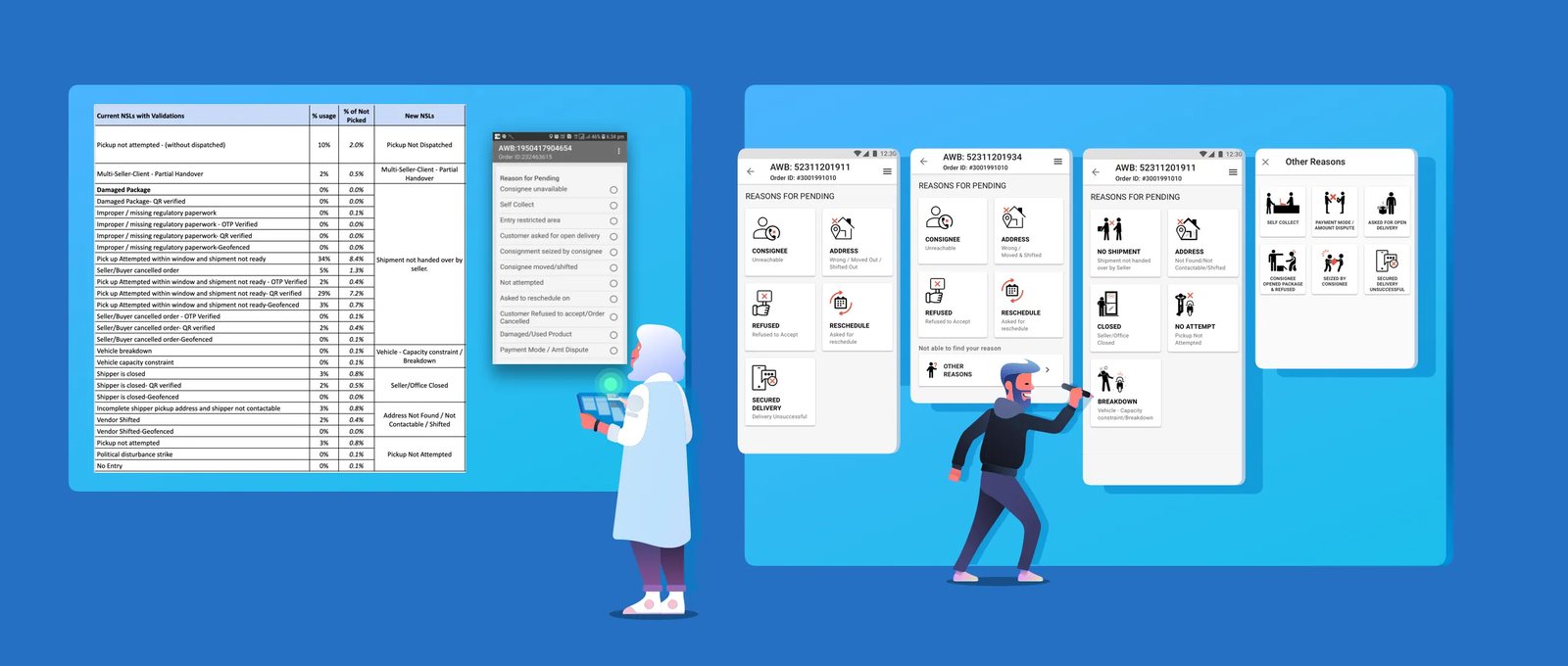
A real case from last-mile operations
At a large logistics company I worked with, a field executive has to mark a parcel as pending when it can't be delivered — and justify why. Operations had proposed an exhaustive list of around 20 reasons. From the business side it covered every case. From the field, it broke a basic principle: special cases should feel like common ones and be easy to use.
The data showed irregular use of those reasons, and a direct link to unclear information under operational pressure. On the ground, the conditions were the point: bright sunlight, heavy loads, short attention spans — and edge cases that only applied in certain locations.
So we ran a customised usability test on Maze, with two success measures: the time it took to complete the task (usability) and how the process made people feel (desirability).

What it proved
A highly usable product isn't automatically a desirable one. Usability is the minimum — there's no experience without it. Desirability is what turns a service people can use into one they want to use. Designers skip it when they assume operators will use the product anyway. They shouldn't.
*Originally published on Medium.*
Read the full piece
This note is a summary. The full essay — with the research, the sketches and the reasoning — lives on Medium at medium.com/@amitchotia9.
Physics taught me you don't get to call it right until it's proven. Most of what I write is me trying to show the working.
Service designJul 20204 min readNo. 05
Service design: usability or desirability?
Why a highly usable service isn't automatically a desirable one — with a real case from last-mile operations.
Words byAmit Chotia
Service design is more than making a service meet a need. And yet we often confuse the job with creating desire for the service — and treat usability and desirability as if they were the same thing.
A design isn't finished until somebody is using it.
Two different jobs
Nielsen Norman Group describes four levels of user experience: utility, usability, desirability and brand experience. A decade ago, solving the problem and making it easy to use was often enough. Not any more. When Apple launched the iPod, it wasn't the first MP3 player or the most usable one — it was the blend of utility, usability and desirability that moved it up the value chain.
Principles I hold to
Design from the purpose of the service, the demand for it and your ability to deliver it. Focus on customer needs, not internal ones. Design the service as a whole, not component by component. Treat special cases as common cases, and design the process to handle them. Design with input from the people who use the service. Prototype against a clear business case before development — and ship a minimum viable service you can improve.
A real case from last-mile operations
At a large logistics company I worked with, a field executive has to mark a parcel as pending when it can't be delivered — and justify why. Operations had proposed an exhaustive list of around 20 reasons. From the business side it covered every case. From the field, it broke a basic principle: special cases should feel like common ones and be easy to use.
The data showed irregular use of those reasons, and a direct link to unclear information under operational pressure. On the ground, the conditions were the point: bright sunlight, heavy loads, short attention spans — and edge cases that only applied in certain locations.
So we ran a customised usability test on Maze, with two success measures: the time it took to complete the task (usability) and how the process made people feel (desirability).
What it proved
A highly usable product isn't automatically a desirable one. Usability is the minimum — there's no experience without it. Desirability is what turns a service people can use into one they want to use. Designers skip it when they assume operators will use the product anyway. They shouldn't.
*Originally published on Medium.*
Read the full piece
This note is a summary. The full essay — with the research, the sketches and the reasoning — lives on Medium at medium.com/@amitchotia9.
Physics taught me you don't get to call it right until it's proven. Most of what I write is me trying to show the working.
Service designJul 20204 min readNo. 05
Service design: usability or desirability?
Why a highly usable service isn't automatically a desirable one — with a real case from last-mile operations.
Words byAmit Chotia
Service design is more than making a service meet a need. And yet we often confuse the job with creating desire for the service — and treat usability and desirability as if they were the same thing.
A design isn't finished until somebody is using it.
Two different jobs
Nielsen Norman Group describes four levels of user experience: utility, usability, desirability and brand experience. A decade ago, solving the problem and making it easy to use was often enough. Not any more. When Apple launched the iPod, it wasn't the first MP3 player or the most usable one — it was the blend of utility, usability and desirability that moved it up the value chain.
Principles I hold to
Design from the purpose of the service, the demand for it and your ability to deliver it. Focus on customer needs, not internal ones. Design the service as a whole, not component by component. Treat special cases as common cases, and design the process to handle them. Design with input from the people who use the service. Prototype against a clear business case before development — and ship a minimum viable service you can improve.
A real case from last-mile operations
At a large logistics company I worked with, a field executive has to mark a parcel as pending when it can't be delivered — and justify why. Operations had proposed an exhaustive list of around 20 reasons. From the business side it covered every case. From the field, it broke a basic principle: special cases should feel like common ones and be easy to use.
The data showed irregular use of those reasons, and a direct link to unclear information under operational pressure. On the ground, the conditions were the point: bright sunlight, heavy loads, short attention spans — and edge cases that only applied in certain locations.
So we ran a customised usability test on Maze, with two success measures: the time it took to complete the task (usability) and how the process made people feel (desirability).
What it proved
A highly usable product isn't automatically a desirable one. Usability is the minimum — there's no experience without it. Desirability is what turns a service people can use into one they want to use. Designers skip it when they assume operators will use the product anyway. They shouldn't.
*Originally published on Medium.*
Read the full piece
This note is a summary. The full essay — with the research, the sketches and the reasoning — lives on Medium at medium.com/@amitchotia9.
Physics taught me you don't get to call it right until it's proven. Most of what I write is me trying to show the working.
Contact…
Let's build the next best experience.
Gurgaon · IST
Hiring for design leadership, or a journey that needs someone to look at it from the other side? Write to me — I reply within a day.
Open toDesign leadership roles
Working from
Contact…
Let's build the next best experience.
Gurgaon · IST
Hiring for design leadership, or a journey that needs someone to look at it from the other side? Write to me — I reply within a day.
Open toDesign leadership roles
Working from
Contact…
Let's build the next best experience.
Gurgaon · IST
Hiring for design leadership, or a journey that needs someone to look at it from the other side? Write to me — I reply within a day.
Open toDesign leadership roles
Working from
That's a wrap.
Thanks for reading to the end. Say hello — I read every message and reply within a day.
Write to meamitchotia9@gmail.com